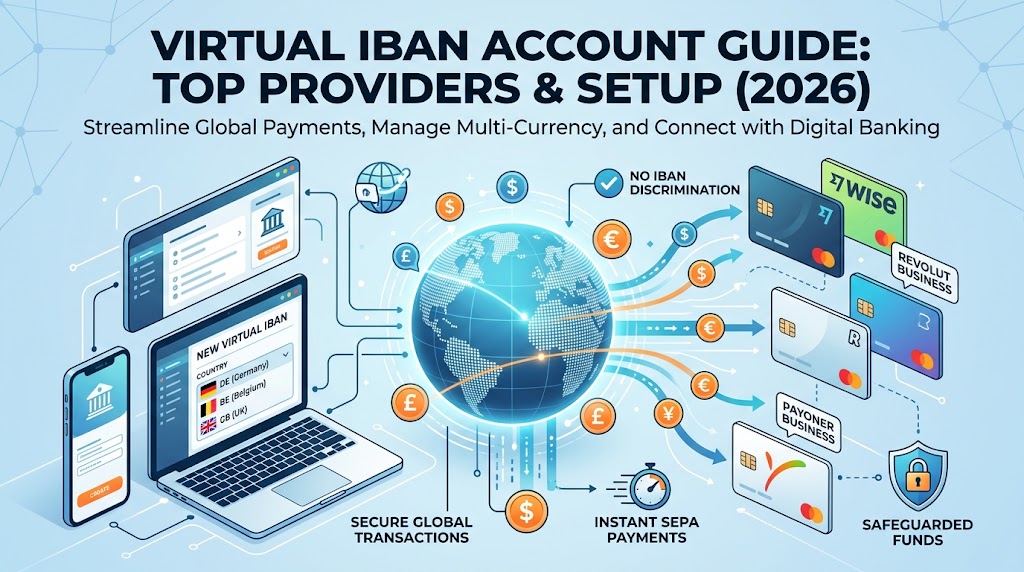
This guide helps you distinguish an IBAN, virtual receiving identifier and local account details before sharing payment instructions. Check the holder, currency, supported payment methods and legal account arrangement; an identifier alone does not establish protection or eliminate fees.
Editorial & Compliance Disclosure: Global Account Guide delivers independent financial reviews and technical guides. Virtual IBAN availability, issuer jurisdictions, and deposit safeguarding protocols vary by provider and user residency. Consult our Financial Disclaimer for complete regulatory notices.
What Is a Virtual IBAN? (vIBAN Architecture Explained)
A Virtual IBAN (vIBAN) is an internationally recognized account number issued by a regulated banking institution or Electronic Money Institution (EMI) that routes incoming and outgoing payments into a central master settlement account. Unlike traditional bank accounts, which link a single physical ledger to one unique account number, virtual IBANs act as an intelligent routing layer.
Do not infer identical payment features from an IBAN’s format. Confirm the account arrangement and supported services. The EBA reports differences in virtual-IBAN models and regulation: see its virtual-IBAN findings.
How the vIBAN Transaction Flow Works:
- Inbound Routing: A client initiates a domestic wire or SEPA transfer to your assigned virtual IBAN. The payment clearing network validates the format and delivers the funds to the issuing institution’s master account.
- Internal allocation: The provider uses the receiving identifier to allocate the payment under its account arrangement. Confirm availability and reconciliation timing; do not assume every receipt becomes spendable instantly.
- Outbound details: Ask which sender name and account identifiers the recipient sees. Confirm that these meet the recipient’s payment-source requirements before sending an important payment.
Comparison Matrix: Top Virtual IBAN Providers (2026)
The table below summarizes leading borderless platforms offering multi-currency virtual IBAN infrastructure for international freelancers, remote companies, and non-residents:
| Receiving details | Identify correctly | Confirm with the provider |
|---|---|---|
| IBAN | Country-specific international account identifier. | Named account holder, eligible payments and account arrangement. |
| US USD details | Routing and account numbers; not a US IBAN. | ACH, wire and debit support are separate features. |
| UK domestic details | Sort code and account number; may be supplied alongside an IBAN. | Supported domestic payment methods and currencies. |
| Other local details | Use the format specified by the receiving institution. | Residence eligibility, personal or business use and fees. |
What an identifier can and cannot tell you
A receiving identifier can help allocate a payment, but the provider’s account arrangement determines what you can do with the balance. Check receiving and sending separately.
| Task | Check before relying on it |
|---|---|
| Receiving an invoice payment | Named holder, accepted sender, currency and payment rail. |
| Matching a receipt | Required reference, reconciliation rules and treatment of missing references. |
| Making a payment | Sender details shown to the recipient and any payment-source restriction. |
| Using a direct debit | Support for the specific scheme and personal or business use. |
| Comparing costs | Receiving, conversion, transfer and account charges; an IBAN is not a fee waiver. |
If a payee rejects your details, record the reason and ask your provider which complaint route applies. Distinguish a country-prefix objection from an unsupported payment method, currency or account arrangement.
Legal Compliance and Asset Safety: Are vIBANs Safe?
Check the issuing entity, applicable jurisdiction and account arrangement. A virtual IBAN is not evidence that the FCA or ECB supervises every provider. The EBA identifies divergent models and regulatory concerns.
- Protection: Identify the legal provider, safeguarding or deposit arrangement and the rules for the exact balance product. An IBAN does not by itself prove that funds are insured or that all risks are covered.
- Full Anti-Money Laundering (AML) Compliance: Issuance of a virtual IBAN requires complete Know Your Customer (KYC) onboarding, including government-issued biometric verification and residential address proof.
Frequently Asked Questions
What is the difference between a traditional IBAN and a virtual IBAN?
A traditional IBAN maps directly to a standalone physical bank account ledger. A virtual IBAN is a programmatic routing number that directs incoming funds into a master segregated holding account while crediting your specific balance.
Can non-residents obtain a European virtual IBAN?
Availability depends on the provider, your actual residence and account use. Confirm eligibility and payment features before applying. Do not present an address or identity document as sufficient for every applicant.
Can a virtual IBAN process SEPA Direct Debits?
Direct-debit support must be confirmed for the specific account, scheme and customer type. Receiving euro transfers does not automatically establish support for consumer or business direct debits.