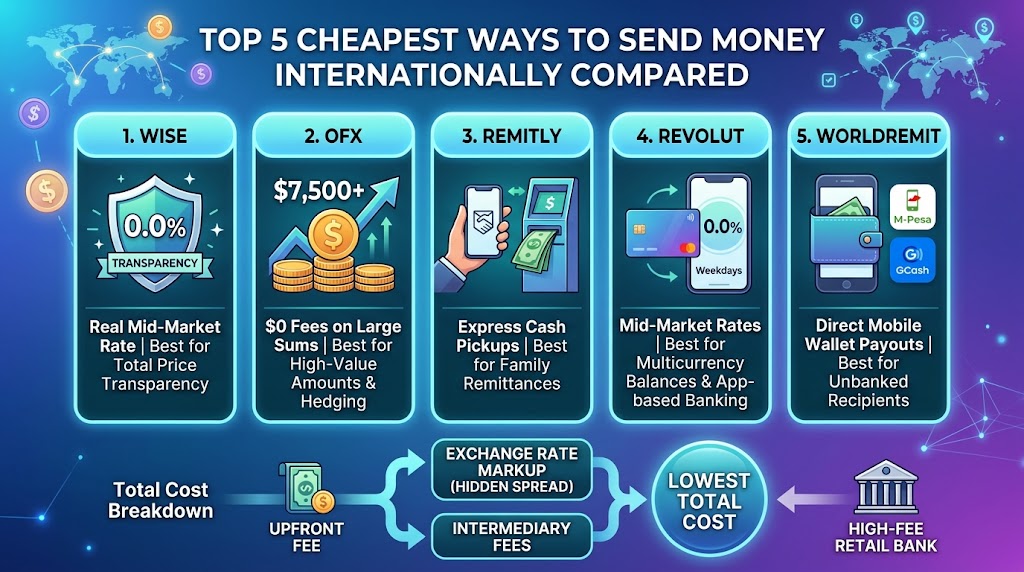
Finding the cheapest ways to send money internationally has historically been challenging due to high wire costs and hidden fees. Traditional retail banks often hide substantial charges behind inflated foreign exchange (FX) rates while charging upfront wire fees. Today, digital cross-border platforms and specialized currency brokers have made it possible to transfer money internationally at a fraction of the cost.
Editorial Disclaimer: Global Account Guide provides independent financial comparisons. Transfer fees, exchange rate markups, and delivery speeds fluctuate based on corridor, payout method, and funding source. Always verify live rates before executing transactions.
The True Anatomy of International Transfer Costs
When sending money abroad, the total cost consists of three distinct components:
- Upfront Transfer Fee: A flat or percentage-based fee charged by the provider to initiate the transaction.
- Foreign Exchange Markup (The Hidden Spread): The difference between the mid-market rate (the real exchange rate seen on Google or Reuters) and the retail rate offered to you. The difference varies by provider and quote; there is no universal percentage.
- Intermediary and Receiving Fees: Third-party correspondent charges when funds route through the traditional SWIFT banking network.
Comparison of the Cheapest Ways to Send Money Internationally
There is no provider that is cheapest for every transfer. Use a live quote for your country, currencies, amount, funding method, and payout method. The table below identifies the information to compare; it does not claim market-wide average fees.
| Comparison field | What to record | Why it matters |
|---|---|---|
| Total sender debit | Amount plus fees paid on top | Compare the same budget |
| Exchange rate | Destination currency per unit of sender currency | A zero upfront fee can coexist with a less favorable rate |
| Recipient amount | Quoted amount and any possible deductions | Shows what is expected to arrive |
| Funding and payout | Bank, card, cash, or wallet | Different methods can have different terms |
| Delivery and quote expiry | Expected time and validity | A cheaper quote may not meet your deadline |
Use our transfer quote comparison worksheet for a same-budget example and a reusable table. Prices previously shown here were not tied to a documented live quote and have been removed.
Top 5 Lowest-Cost Methods in Detail
1. Wise: Best for Total Price Transparency
Use Wise’s live quote to record the total debit, displayed rate, fee, and expected recipient amount. Confirm the funding and payout routes. Do not infer that every transfer avoids Swift or third-party bank charges.
2. OFX: Best for High-Value Amounts and Hedging
When comparing OFX with another provider, request a quote for the same total budget and delivery requirement. Confirm minimum amounts, the rate offered, any transfer fee, and the conditions of a forward contract or other product before committing. A large transfer is not automatically cheapest with one provider.
3. Remitly: Best for Cash Pickups and Remittance Corridors
For Remitly, compare the exact funding and payout choices shown for your destination. Check whether an introductory promotion applies, when it expires, and whether the next transfer uses different pricing. Cash pickup and bank deposit should be compared separately.
4. Revolut: Best for Multicurrency Balances
Revolut exchange charges depend on the market, plan, usage, and timing. For example, its Spain fee guidance distinguishes plans and weekend charges. Use the help page for your own country and the actual in-app quote; do not assume a universal mid-market rate or zero total fees.
5. WorldRemit: Best for Direct Mobile Wallet Payouts
For WorldRemit, confirm which payout options are available for your specific destination, the quoted recipient amount, and expected delivery. Mobile-wallet availability and price should be checked for the selected route, rather than inferred from a worldwide product description.
Finding the cheapest ways to send money internationally requires calculating both explicit upfront fees and hidden foreign exchange spreads.
Compare the net recipient amount with the same budget
Use the same total sender debit, destination currency and payout method. Keep any recipient deduction in the recipient’s currency; adding it directly to a fee in another currency produces a meaningless total.
Invented quotes for arithmetic only: a $1,000 total budget with a $4.50 fee deducted before conversion leaves $995.50. At 0.9200 EUR/USD it delivers €915.86. A second quote deducts $30, converts $970 at 0.8850 and delivers €858.45. The first delivers €57.41 more, assuming no additional deductions. These are not current prices or evidence that a fintech is always cheaper than a bank.
Effective rate = net recipient amount ÷ total sender debit. Record the units and quote time. If the fee is paid on top, include it in the sender debit; if a recipient deduction is unknown, mark the comparison as uncertain. Use the full quote worksheet to record each component.
Costly Mistakes to Avoid
- Using Credit Cards for Funding: Some card issuers may treat transfer funding as a cash advance or apply other charges. Check your issuer’s terms before funding with a credit card.
- Trading on Weekends: Check whether your provider and plan apply a weekend charge; it is not a universal fee.
- Falling for “Zero Commission” Marketing: A zero upfront fee does not establish a lower total cost. Compare the rate and recipient amount.
Frequently Asked Questions
What is the cheapest way to send small amounts (under $500)?
Compare live quotes with the same total debit and payout method. Fixed fees, exchange-rate differences, promotions, and recipient deductions can change which quote is cheaper. The amount alone does not identify a universally cheapest provider.
Do receiving banks charge for incoming international wires?
The receiving bank or an intermediary may charge a fee, depending on the route and account terms. Ask the provider whether the quoted recipient amount includes known deductions and which charges remain uncertain.
Are digital transfer platforms safe and regulated?
Check the legal entity and authorization applicable to your country. FinCEN states that MSB registration is not a recommendation or endorsement. For UK non-bank payment providers, the FCA explains safeguarding and its differences from FSCS deposit protection. Do not infer universal deposit insurance from a registration or a familiar brand name.