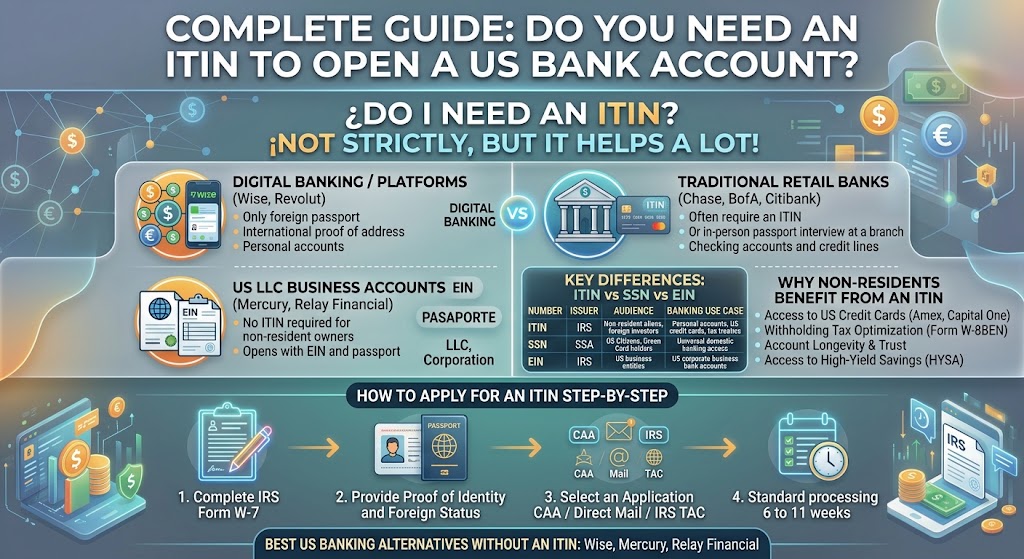
An Individual Taxpayer Identification Number (ITIN) is issued by the IRS for federal tax purposes to people who need a US taxpayer number and are not eligible for an SSN. This article helps you separate tax eligibility from bank-account eligibility before applying.
Important: The IRS does not issue an ITIN solely to open a bank or investment account. A bank may request a tax number as part of its own application, but that does not by itself establish eligibility for an ITIN.
Do You Need an ITIN to Open a US Bank Account?
There is no single answer for every bank and every applicant. Confirm the selected provider’s requirements for your actual residence and account type. An ITIN does not guarantee acceptance.
Under federal regulations enforced by FinCEN (Financial Crimes Enforcement Network) and Customer Due Diligence (CDD) rules, US financial institutions must verify account holder identities. While domestic residents submit a Social Security Number, federal regulations allow banks to accept alternative documentation from foreign non-residents, such as a valid passport and foreign tax identification number.
Before applying, ask the provider these questions:
- Do you accept applicants resident in my country?
- Is this a personal account, a company account, or a payment-service account?
- Which tax number and identity documents are accepted for my circumstances?
- Is a branch visit required, and what residential-address evidence is needed?
- Which entity will hold the funds, and what protection applies to that particular product?
ITIN vs. SSN vs. EIN: Key Differences for Non-Residents
Foreign founders and international contractors often confuse US tax identification numbers. Here is a direct comparison:
| Number | Key distinction | Application check |
|---|---|---|
| SSN | Personal number issued by the Social Security Administration | If you are eligible for an SSN, do not apply for an ITIN instead |
| ITIN | Personal IRS number for a federal tax purpose when an SSN is unavailable | Confirm your tax reason; it does not guarantee bank approval |
| EIN | IRS business tax identifier | Do not confuse a company’s number with an owner’s personal identifier |
Separate the tax purpose from marketing promises
Do not apply for a tax number because a comparison article promises credit access, reduced account freezes, or automatic treaty savings. Check the tax purpose and financial-product conditions separately.
- Tax records: Establish whether you need a federal tax identifier and whether you are eligible for an SSN instead.
- Provider terms: Confirm requirements directly with the bank or issuer before spending money on applications.
- Truthful documentation: Supply your actual residence, address, ownership information, and tax status. Do not use a borrowed address to bypass eligibility checks.
If you have a valid tax reason to apply
Read the current Form W-7 instructions and our guide to applying from abroad. That guide compares mail, an authorized agent, and an IRS appointment. Choose a route based on document handling and your tax circumstances, rather than on promised financial-product access.
Best US Banking Alternatives Without an ITIN
If you need immediate USD receiving rails while waiting for your application, check our breakdown of the best US banks for non-residents without SSN or review our foundational guide on how to open a US bank account as a non-resident.
A provider offering USD receiving details may be a payment service rather than a personal US bank account. A US company account also serves a different purpose from a personal account. Check eligibility and product terms directly; do not assume that a passport alone gives immediate access.
Frequently Asked Questions
Can I open a US bank account with only an ITIN?
Not with an ITIN alone. Ask the chosen institution which identity, address, residence, and tax documents it requires. Approval depends on the institution’s review.
Does an ITIN expire?
Yes. An ITIN expires if it is not used on a federal tax return at least once in three consecutive tax years.
Can I build US credit with an ITIN?
Some issuers may accept an ITIN, but residence, income, credit history, and product rules still matter. Check the issuer’s current requirements; an ITIN does not create a credit history by itself.