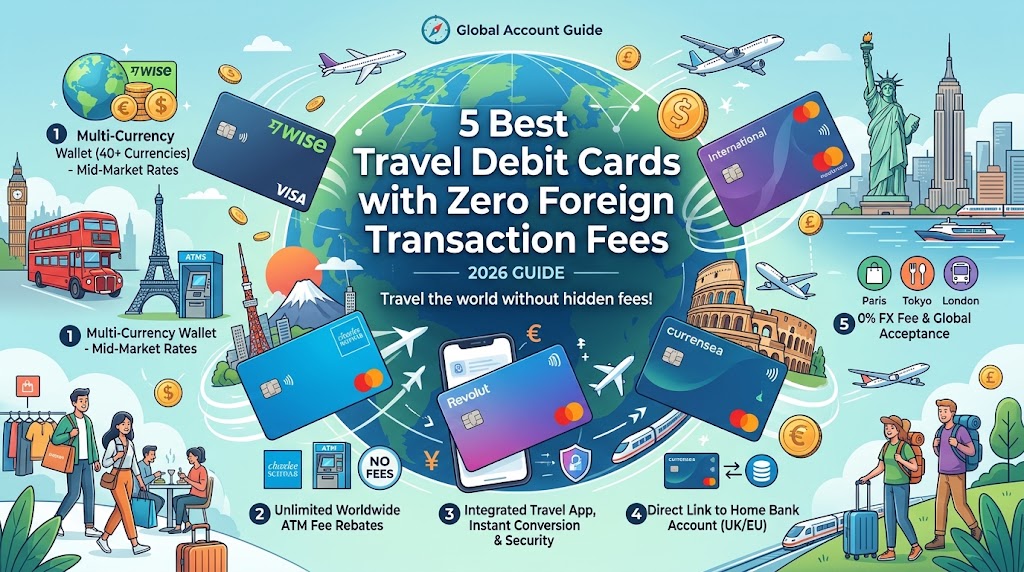
Compare a travel card using the costs of your intended purchases and cash withdrawals. “No foreign transaction fee” does not necessarily mean no conversion charge, subscription cost or ATM operator fee. This guide compares four options and shows the questions to check for your residence and trip.
Editorial & Travel Advisory Notice: Global Account Guide provides independent financial reviews. ATM fee reimbursement policies, daily spending thresholds, and multi-currency conversion margins depend on user legal residency. Review our Financial Disclaimer for regulatory compliance notices.
The Anatomy of International Spending Fees
When you swipe a standard domestic debit card abroad, traditional retail banks usually levy multiple compounding charges behind the scenes:
- Foreign Transaction (FX) Fee: An administrative surcharge (typically 2.5% to 3.5%) added to every transaction executed in a foreign currency.
- Out-of-Network International ATM Fee: A fixed fee of $2.50 to $5.00 charged by your home bank for using an overseas ATM terminal.
- Dynamic Currency Conversion (DCC): A retail terminal conversion trick where the merchant charges you in your home currency using a predatory foreign exchange spread of up to 8%.
Comparison Matrix: Travel Card Costs to Check
The table below provides a detailed comparison of the leading travel cards featuring zero foreign transaction surcharges, mid-market currency rates, and international ATM limits:
| Card | Compare for your trip | Eligibility question |
|---|---|---|
| Wise | Actual conversion quote and withdrawal tariff | Is the card available for your country of residence? |
| Schwab Investor Checking | Spending conversion and ATM rebate exclusions | Can you open and maintain the required accounts? |
| Revolut | Plan cost, exchange allowance and ATM limits | Which legal entity and plan serve your address? |
| Currensea | Linked-bank eligibility and spending or ATM charges | Does your home bank and residence meet the current requirements? |
Detailed Breakdown: Top Travel Debit Cards
1. Wise: Check Conversion and Withdrawal Charges
The Wise card connects directly to your borderless multi-currency wallet. Whenever you pay in a store or restaurant abroad, the card automatically debits that specific local currency balance. If you don’t hold the local currency, it intelligently converts funds from whichever wallet balance has the lowest conversion fee at the live mid-market rate.
2. Charles Schwab Bank Visa Platinum: The ATM Fee King
For Schwab Investor Checking, confirm account eligibility, linked-account requirements and the ATM rebate exclusions in the official FAQs. Distinguish a refunded withdrawal surcharge from a currency-conversion or other ATM service charge.
3. Revolut: The Best Integrated Travel Lifestyle Card
For Revolut, confirm the plan and legal entity available for your residence. Compare its actual exchange quote, allowance and withdrawal tariff. Card-security features and conversion charges can differ by product and plan.
4. Currensea: The Direct Debit Layer
For Currensea, confirm which home-bank accounts can be linked and whether you meet the current eligibility rules. Compare the offered rate, plan price, withdrawal conditions and how charges are collected from the linked account.
Essential Rules to Avoid Surcharges When Spending Abroad
- Always Opt to Pay in Local Currency (Bypass DCC): When an international card terminal or ATM asks whether you want to be billed in your home currency or the local currency (e.g., EUR, JPY, THB), always choose the local currency.
- Avoid Independent Operator ATMs: Independent commercial ATM networks located in tourist zones and airports (such as Euronet) frequently add high operator markups. Prioritize official retail bank ATMs.
- Check the booking payment type: Confirm whether a payment involves a deposit, delayed charge or card presentation. Do not assume a disposable card works for hotels or transport. Revolut’s single-use-card guidance lists exclusions including deposits and subscriptions.
Regulatory Standards and Security Protections
Modern travel debit cards operate under rigorous institutional oversight from bodies like the UK Financial Conduct Authority (FCA) and the US Federal Deposit Insurance Corporation (FDIC):
- Instant Digital Freezing: Freeze and unfreeze physical cards instantly within your mobile dashboard if lost or misplaced.
- Balance protection: Identify the legal entity and product. Eligible bank deposits, safeguarded payment balances and investments have different protections; a card network logo does not establish a deposit-insurance limit.
Worked example: withdrawal count changes the cheaper card
Invented tariffs for arithmetic only; these are not prices for the four cards above. Assume you withdraw a total of $600 equivalent, with no subscription, operator fee or exchange-rate difference. Card A charges $3 per withdrawal plus 1% of cash withdrawn. Card B charges 2% with no fixed withdrawal charge.
| Withdrawal pattern | Card A | Card B | Lower issuer charge |
|---|---|---|---|
| One $600 withdrawal | $3 + $6 = $9 | $12 | A by $3 |
| Three $200 withdrawals | $9 + $6 = $15 | $12 | B by $3 |
For these invented tariffs, A and B break even when total cash C equals $300 multiplied by the number of withdrawals n: 3n + 0.01C = 0.02C. At three withdrawals that is $900. The result changes if an operator charges a fee, an allowance applies, rates differ or a monthly plan is required. Use a cash amount that fits your trip and security needs; the cheapest arithmetic does not establish a safe withdrawal size.
Before leaving, record your expected cash total, withdrawal count, issuer tariff, allowance, operator charges and exchange quote. Keep fixed fees and percentage fees separate. For transfer costs, use our equal-budget quote worksheet.
Frequently Asked Questions
Are these travel debit cards accepted at all international ATMs?
A matching network logo is a useful first check, not a guarantee. Issuer restrictions, cash limits, terminal availability and local rules can prevent a withdrawal. Keep a backup method and confirm the fee before accepting the transaction.
What is the difference between a credit card and a debit card for travel?
Credit cards allow you to borrow against a credit line and may require extensive credit scoring. Travel debit cards operate against your actual deposited capital, making them accessible to non-residents, freelancers, and nomads without complex local credit checks.
What should I do if an ATM terminal tries to charge an operator fee?
If an ATM displays a mandatory local operator fee on screen, you can decline the transaction and locate a local retail bank ATM, which often features lower or zero fixed terminal fees.