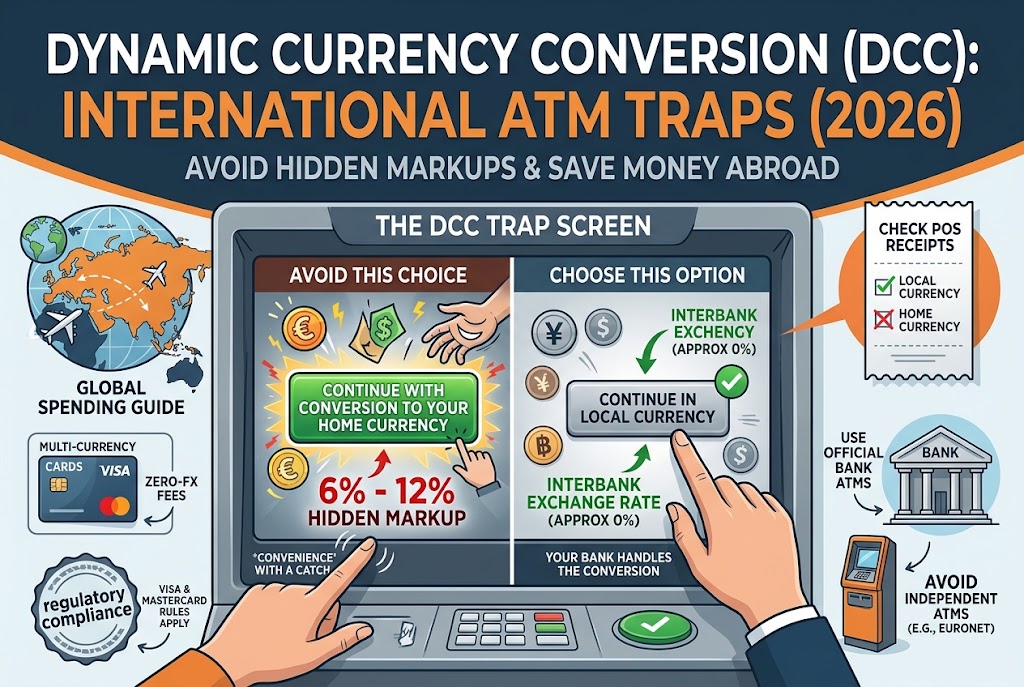
At an overseas ATM or card terminal, you may be offered a charge in your home currency. This is dynamic currency conversion (DCC). Compare the displayed rate and markup before choosing; accepting a familiar currency amount does not establish that the conversion is cheaper.
Editorial & Financial Safety Notice: Global Account Guide provides factual guides on international spending, ATM fee avoidance, and cross-border consumer protections. Foreign exchange rates, merchant acquiring regulations, and terminal compliance rules vary by jurisdiction. Review our Financial Disclaimer for regulatory details.
What Is Dynamic Currency Conversion (DCC)?
Dynamic Currency Conversion (DCC), sometimes marketed as Cardholder Preferred Currency (CPC), is an optional financial service offered at international ATMs and Point-of-Sale (POS) terminals. When you insert or tap a foreign-issued card, the terminal identifies the card’s origin and asks whether you prefer to be billed in the local currency or in your domestic home currency (e.g., USD, GBP, or EUR).
With DCC, the merchant or ATM’s conversion offer sets the home-currency amount. If you decline DCC and choose local currency, your card’s own conversion and fee rules apply. Neither option should be described as automatically fee-free.
How the DCC Exchange Rate Markup Works
DCC is a conversion choice. The practical issue is whether you receive clear pricing and can make an informed choice.
- Local-currency charge: Check your issuer’s conversion rate and applicable charges.
- Home-currency DCC charge: Check the displayed conversion rate, markup, and total home-currency amount. Do not assume a fixed markup percentage.
How to read ATM and terminal conversion prompts
Read the currency and total amount on the confirmation screen. Button wording varies; distinguish declining the conversion from cancelling the whole withdrawal.
Independent ATM operators and tourist-heavy merchant terminals use interface designs and psychological cues to encourage users to accept unfavorable conversions. The table below details standard screen prompts and the correct action to take:
| Prompt | What to check |
|---|---|
| With conversion / home-currency amount | Displayed rate, markup, and total debit |
| Without conversion / local-currency amount | The local amount plus your own card’s conversion and fee rules |
| Guaranteed exchange rate | A known rate is not proof of a lower total price |
| No clear choice or missing price details | Decline the offer and contact the issuer if necessary |
Separate the ATM access fee from conversion costs
ATM access fees and currency-conversion charges are separate. Check both, including at a bank-owned ATM. The brand or location alone does not establish that a withdrawal is cheaper.
- ATM access fee: Read the operator’s charge before confirming.
- Conversion offer: Separately read the DCC rate and markup if offered.
If the displayed charges are unacceptable, cancel before confirming and compare another ATM. Check your card’s withdrawal limits and fees before travelling.
Essential Rules to Avoid Dynamic Currency Conversion
- Always Select the Local Currency: Whether paying for dinner, buying a train ticket, or withdrawing cash, choose the currency of the country you are physically standing in.
- Check the POS Receipt Before Authorizing: If a merchant terminal displays your home currency automatically without giving you an on-screen choice, ask the clerk to re-run the charge in the local currency.
- Use Zero-FX Multi-Currency Cards: Check conversion charges, withdrawal limits, and provider terms for the specific card and country. A multi-currency card does not guarantee a free withdrawal.
Regulatory Standards and Consumer Protections
Visa’s DCC guidance says that its merchants and ATMs should display both currency amounts, the exchange rate, and any markup, and let the cardholder choose. Visa recommends declining the offer if required details are missing or the choice is pressured. These are card-network requirements; this article does not determine the law in every jurisdiction.
Visa’s travel guidance recommends local-currency payment to avoid the merchant’s conversion markup. Your issuer may still apply its own charges. Retain the receipt and compare the actual debit with the amount you authorized.
Frequently Asked Questions
Is the dynamic currency conversion ATM scam illegal?
DCC is an optional conversion service. A transaction with missing disclosure or no meaningful choice is a different issue from an informed acceptance of the service. Whether a particular practice is unlawful depends on the applicable rules and circumstances.
What should I do if a card machine charges me in home currency without asking?
Ask the merchant to correct the currency before completing payment. If the transaction has already been processed in a currency you did not choose, keep the receipt and contact your card issuer to discuss the charge. Do not assume a refund is guaranteed.
Does paying in local currency prevent all ATM fees?
No. Declining DCC avoids that conversion offer, but your card can still charge conversion or withdrawal fees and the ATM can charge an operator fee. Reimbursement cards have terms and exclusions; they do not provide universal protection from every charge.