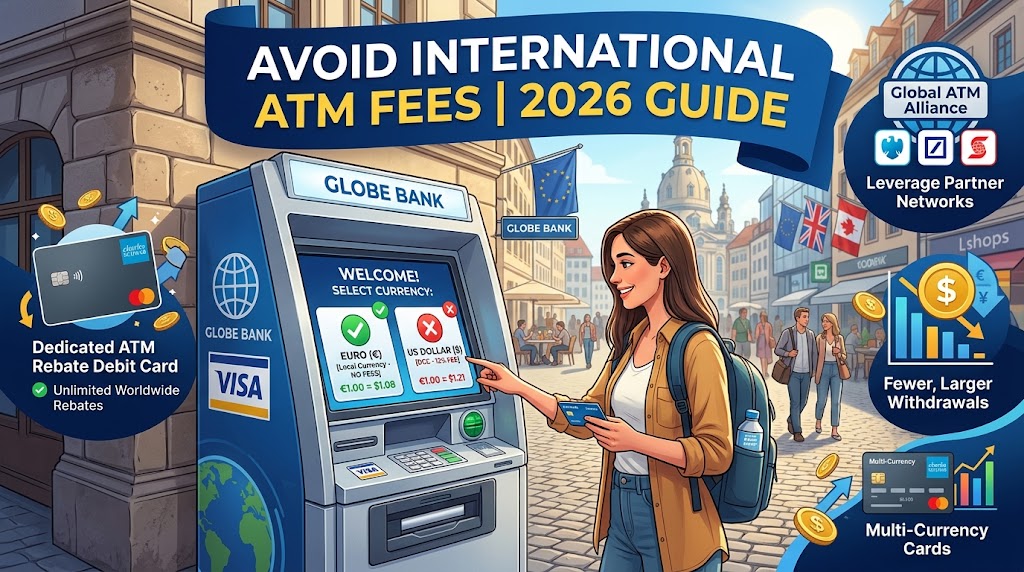
Withdrawing physical cash while traveling abroad often incurs unexpected banking fees. Learning how to avoid international atm fees allows digital nomads, tourists, and expats to access local currencies at wholesale interbank rates, bypass local operator surcharges, and protect their travel budget from compounded cross-border expenses.
Editorial & Financial Safety Notice: Global Account Guide provides factual guides on international banking, card processing networks, and cash management abroad. ATM operator fee policies, foreign exchange rate margins, and partner network terms vary by jurisdiction and card tier. Review our Financial Disclaimer for regulatory compliance information.
The Anatomy of an Overseas ATM Charge
When you insert a domestic debit card into a foreign cash machine, up to three separate financial institutions can attach fees to that single withdrawal:
- Home Bank Out-of-Network Surcharge: A flat charge ($2.00 to $5.00) or percentage markup (1% to 3%) assessed by your primary domestic institution for processing an international withdrawal.
- Foreign ATM Operator Direct Access Fee: A local terminal surcharge ($3.00 to $8.00) imposed by the owner of the ATM machine for using their hardware.
- Foreign Exchange (FX) Spread / Dynamic Currency Conversion (DCC): A currency conversion markup applied either through retail spreads or predatory terminal conversion algorithms.
Comparison Matrix: Best Solutions to Avoid International ATM Fees (2026)
The table below summarizes leading banking platforms and card solutions offering fee-free foreign cash withdrawals and terminal surcharge reimbursements:
| Account or card | Check before withdrawing | Costs that can remain |
|---|---|---|
| Schwab Investor Checking | Eligibility and the current ATM rebate exclusions | Dynamic currency conversion and charges outside the rebate terms |
| Wise debit card | Country-specific withdrawal allowance, number of withdrawals and excess fees | ATM operator charges and conversion fees |
| Revolut | Your plan’s withdrawal allowance and exchange conditions | Operator charges, excess withdrawals and conversion costs |
| ATM alliance participation | Your bank’s current partner list and eligible machines | Foreign exchange costs or charges not covered by the alliance |
5 Proven Strategies to Avoid International ATM Fees
1. Use a Dedicated ATM Rebate Debit Card
An account with ATM rebates can reduce qualifying operator charges. Check the account’s eligibility, rebate timing and exclusions, and keep receipts where required. A rebate does not establish that currency conversion, cash advances or every charge is covered.
2. Leverage Global ATM Alliances
Major international retail banks participate in reciprocal agreements to waive out-of-network access fees across partner networks. For instance, the Global ATM Alliance includes Bank of America (USA), Barclays (UK), BNP Paribas (France), Deutsche Bank (Germany), and Scotiabank (Canada/Latin America). Withdrawing cash from a partner bank machine eliminates the primary non-network access fee.
3. Consolidate into Fewer, Larger Cash Withdrawals
Illustrative arithmetic: if an ATM charges a fixed $5 per withdrawal, four withdrawals of $100 cost $20 on $400 of cash, or 5%. One $400 withdrawal costs $5, or 1.25%. These are invented terms, not a universal ATM fee. Cash security, withdrawal limits, issuer fees and exchange costs still matter; do not carry more cash than is appropriate for your situation.
4. Always Decline Dynamic Currency Conversion (DCC)
When an ATM offers conversion into your home currency, compare its displayed amount with your card’s conversion rules and charges. Choosing local currency leaves conversion to the card arrangement; it does not remove issuer or operator fees. There is no universal 12% markup that applies to every ATM.
5. Pair with a Multi-Currency Debit Card
A card advertised without a foreign transaction fee can still involve conversion, withdrawal, operator or subscription charges. Compare the actual account tariff and the ATM’s offer. Holding the withdrawal currency does not itself remove every charge.
High-Cost ATM Traps to Avoid When Traveling
- Independent White-Label Machines: Standalone kiosks located in convenience stores, gas stations, and nightlife districts (such as Euronet or Travelex) consistently levy the highest access surcharges and aggressive DCC conversion prompts.
- Airport and Ferry Terminal ATMs: Terminal operators in transit hubs capitalize on captive travelers by enforcing low cash withdrawal caps and high transaction fees.
- Conversion timing: Check the current account and plan tariff for any timing-related charge rather than assuming a universal weekend percentage.
Regulatory Oversight and Safety Standards
Payment systems and cash withdrawal networks are regulated under international standards enforced by organizations such as the UK Financial Conduct Authority (FCA) and the US Consumer Financial Protection Bureau (CFPB):
- Mandatory Fee Disclosures: ATM operators are legally required to display any direct access surcharge on the terminal screen before completing the transaction, giving you the right to cancel.
- Physical Branch Protection: For maximum personal safety and to minimize card-skimming risks, prioritize using ATMs located inside the secure lobbies of licensed commercial banks during standard business hours.
Frequently Asked Questions
How can I identify if an ATM will charge an access fee before withdrawing?
Under international card network regulations, an ATM must show any direct operator access fee on the digital screen prior to dispensing cash. If the fee is unacceptable, you can cancel the transaction with zero cost.
Is it cheaper to withdraw cash from an ATM or use an airport exchange booth?
Compare the net local cash delivered for the same total cost when considering an ATM or currency counter. Include fixed charges, the conversion rate and any issuer charge. A “zero-FX” label or an airport location alone does not establish which offer is cheaper.
What should I do if an international ATM retains my debit card?
Instantly freeze the card via your mobile banking application to prevent unauthorized charges, notify the local branch staff if open, and switch to a backup physical or digital card.