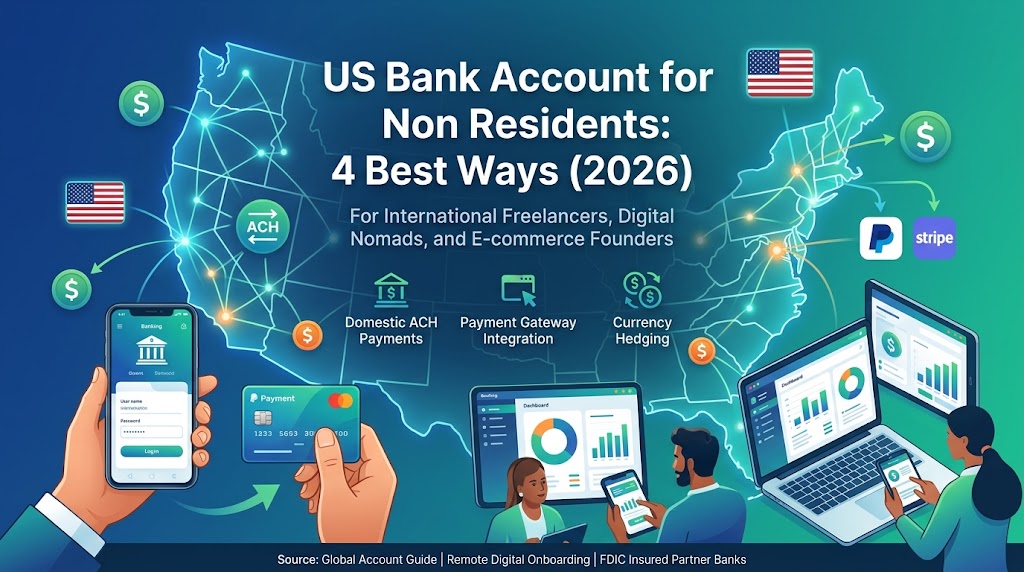
Accessing the United States financial ecosystem is critical for international freelancers, digital nomads, and non-US e-commerce founders. Securing a US bank account for non residents allows you to collect domestic ACH payments, connect seamlessly to US payment gateways, and avoid foreign currency exchange spreads.
Editorial & Regulatory Notice: Global Account Guide provides factual guides on international banking. Requirements regarding foreign taxpayer compliance, remote identity verification, and FDIC insurance eligibility depend on provider terms and your country of residence. Review our Financial Disclaimer for complete regulatory disclosures.
Can a Non-Resident Open a US Bank Account?
Yes. Federal United States banking regulations do not prohibit non-residents or foreign nationals from holding US deposit accounts. While the USA PATRIOT Act requires financial institutions to implement strict Customer Identification Programs (CIP), licensed banks and fintech platforms are legally permitted to verify foreign clients using an international passport and foreign tax documentation.
Core Benefits of a US Bank Account for Non-Residents:
- Domestic ACH Transfers: Receive direct deposits via the Automated Clearing House (ACH) network with zero intermediary wire deductions.
- Payment Gateway Integration: Seamlessly link US Dollar balances directly to Stripe, PayPal, and Amazon US seller accounts.
- Hedging Against Currency Devaluation: Hold working capital directly in USD without forced conversions into local currencies.
Comparison: Best US Accounts for Non-Residents (2026)
The table below analyzes leading options to open a US bank account for non residents remotely, comparing account types, SSN/ITIN requirements, and deposit protections:
| Provider | Account Category | SSN / ITIN Needed? | Deposit Protection | Monthly Fee |
|---|---|---|---|---|
| Wise USD Balance | Personal / Business Multi-Currency | No (Passport only) | FDIC pass-through (partner banks) | $0 / month |
| Mercury | US Business Banking | No (Requires US LLC + Passport) | FDIC insured up to $5,000,000 | $0 / month |
| Relay Financial | US Business Banking | No (Requires US LLC + Passport) | FDIC insured up to $3,000,000 | $0 – $30 / month |
| Traditional Banks (Chase, BofA) | Retail Checking / Savings | Usually requires ITIN + in-person visit | Standard FDIC up to $250,000 | $0 – $25 / month |
Step-by-Step: How to Open a US Account Remotely
Step 1: Choose Between Personal and Corporate US Banking
If you are an individual freelancer receiving payments from international clients, a personal multi-currency account with US routing credentials (like Wise) is the fastest option. If you run an e-commerce brand or SaaS company, registering a US LLC (e.g., in Wyoming or Delaware) allows you to open dedicated corporate US accounts through Mercury or Relay Financial entirely online.
Step 2: Prepare Identification and Legal Documentation
You will need standard identity verification documents:
- Valid Biometric Passport: Clear high-resolution color scan of your valid international passport.
- Foreign Proof of Address (POA): A bank statement or utility bill from your home country issued within the last 90 days.
- Corporate Documents (For Business Accounts): Certificate of Formation, Operating Agreement, and your official Employer Identification Number (EIN) confirmation letter (Form CP 575 or 147C) from the Internal Revenue Service (IRS).
Step 3: Complete Biometric KYC Verification
Modern US fintech platforms use automated Know Your Customer (KYC) workflows. You will take a real-time selfie or short liveness video via your mobile device to match your face with your passport photo.
Step 4: Receive Your ACH Routing and Account Numbers
Once approved, you receive standard US banking coordinates:
- 9-Digit ABA/ACH Routing Number: Used for zero-fee domestic deposits and linking to digital wallets.
- Domestic Account Number: Your unique checking or deposit account identifier.
- Wire Routing Number / SWIFT Code: For receiving international incoming wire transfers.
Tax Obligations: Form W-8BEN and FATCA
Non-residents receiving income via a US bank account must understand their tax reporting status:
- Form W-8BEN (Certificate of Foreign Status): Foreign individuals submit this form to certifying platforms and clients to establish that they are non-resident aliens. This prevents the standard 30% automatic IRS withholding tax on non-US source business income.
- Foreign Account Tax Compliance Act (FATCA): US financial institutions are mandated to maintain accurate records of foreign account holders and report non-resident account information to the IRS under international tax exchange agreements.
Common Mistakes to Avoid
- Using Virtual Address Services for Personal Accounts: Many personal fintech providers reject registered agent or commercial mail forwarding addresses for personal KYC. Use your real home address.
- Initiating Transfers via SWIFT Instead of ACH: Whenever possible, instruct US clients to send funds via domestic ACH direct deposit rather than wire transfers to avoid unnecessary banking surcharges.
- Neglecting Inactive Accounts: Traditional US banks charge monthly maintenance fees ($12–$25) unless you maintain minimum daily balances.
Frequently Asked Questions
No. Foreign non-residents can open a US bank account for non residents through digital multi-currency platforms or corporate fintech providers using an international passport and an EIN or foreign tax ID.
Can I open a US bank account without traveling to the United States?
Yes. Specialized business platforms (Mercury, Relay) and multi-currency providers (Wise) offer 100% remote digital onboarding without requiring physical travel to a US branch.
Are funds held by non-residents protected by FDIC insurance?
Yes. FDIC insurance applies to the deposit account itself, not the citizenship status of the account holder. Deposits in partner banks are insured up to $250,000 per depositor per ownership category.