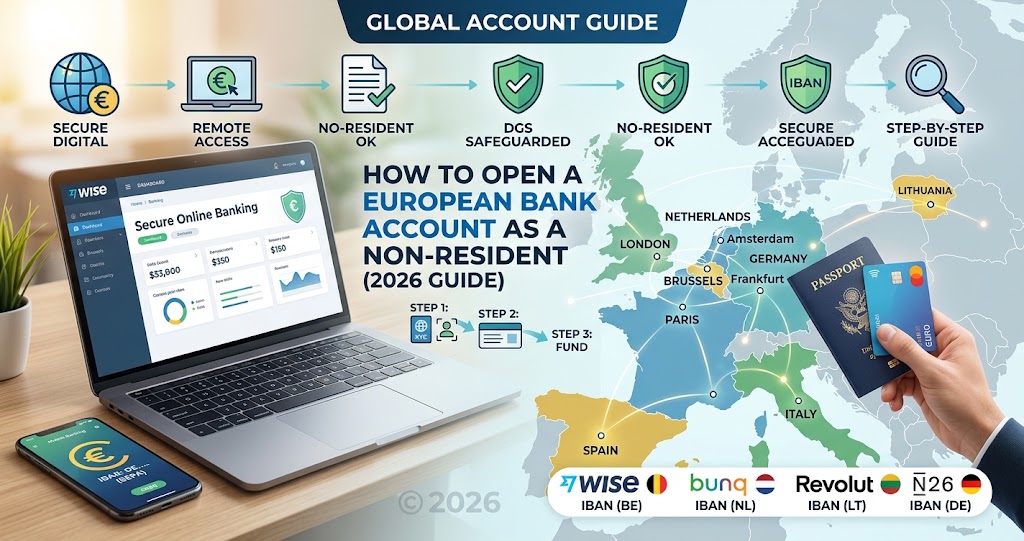
Securing a European bank account is a crucial step for non-residents, international freelancers, remote contractors, and real estate investors. Knowing how to open European bank account non resident options legally and remotely provides seamless access to the Single Euro Payments Area (SEPA), eliminates cross-border wire surcharges, and secures multi-currency liquidity without requiring physical EU residency.
Editorial & Compliance Notice: Global Account Guide publishes independent banking comparisons. Account availability, KYC requirements, and acceptance of non-EEA tax residencies vary by country and institution. Review our Financial Disclaimer for regulatory guidelines.
Traditional EU Banks vs. Licensed European EMIs
Opening an account with a traditional brick-and-mortar European bank (such as BNP Paribas, Santander, or Deutsche Bank) as a non-resident typically involves complex bureaucratic friction: mandatory in-person visits, certified translations of tax records, and local utility bills within the European Economic Area (EEA).
In contrast, fully regulated Electronic Money Institutions (EMIs) and digital neo-banks allow qualified foreign nationals to open European bank account non resident profiles entirely online using remote biometric verification and international proof of address.
Comparison: Best European Accounts for Non-Residents (2026)
The table below summarizes leading European financial platforms accepting non-resident applicants, detailing IBAN jurisdictions, regulatory protection, and documentation requirements:
| Provider | IBAN Country | Non-EEA Applicants | Protection Type | Monthly Fee |
|---|---|---|---|---|
| Wise Account | Belgium (BE) / Germany (DE) | Yes (170+ Countries) | Tier-1 Custodian Safeguarding | $0 / month |
| bunq | Netherlands (NL), DE, FR, ES, IE | Yes (Selected Nationalities) | Dutch DGS (Up to €100,000) | €3.99 – €18.99 / mo |
| Revolut Bank | Lithuania (LT) / Local Branches | Requires EEA Visa or Residence | Lithuanian DGS (Up to €100,000) | $0 – $16.99 / mo |
| N26 Bank | Germany (DE) / Spain (ES) / Italy (IT) | Restricted (EEA Address Only) | German DGS (Up to €100,000) | €0 – €16.90 / mo |
Step-by-Step Guide: How to Open a European Account Remotely
Step 1: Choose Your Regulatory Model and IBAN Type
Determine whether your financial activity requires statutory deposit insurance (via a licensed digital bank like bunq) or cross-border payment flexibility with multi-currency balances (via an EMI like Wise). For receiving international transfers, having a dedicated Eurozone IBAN prefix (such as BE, NL, or DE) guarantees full integration with SEPA and SEPA Instant.
Step 2: Complete the Digital KYC Process
EU anti-money laundering (AML5/AML6) regulations require all providers to verify customer identities through digital Know Your Customer (KYC) workflows:
- Identity Document: A valid biometric international passport with at least 6 months of validity.
- Liveness Verification: A real-time selfie or short automated video verification to confirm identity against passport data.
Step 3: Submit Non-Resident Proof of Address (POA)
Unlike traditional banks that require local European utility bills, non-resident friendly providers accept documentation issued in your home country (provided it is dated within the last 90 days):
- A formal statement from your domestic bank showing your full name and residential address.
- A municipal utility statement (electricity, water, or fixed broadband).
- An official government tax return or municipal registration document.
Step 4: Tax Residency Declaration (CRS Compliance)
Under the international Common Reporting Standard (OECD CRS), you must submit your home country Tax Identification Number (TIN/SSN/NIE). Declaring your foreign tax status ensures full compliance without creating unverified local tax liabilities in Europe.
Step 5: Fund Your Account to Activate Your Dedicated IBAN
Most providers require an initial micro-deposit ($20–$50 or equivalent) via credit card or an existing bank account in your name to finalize account setup and issue your active European IBAN.
Key Benefits of Having a Non-Resident European IBAN
- Free SEPA Transfers: Transfer funds across all 36 SEPA member states with standard processing times of under 10 seconds via SEPA Instant.
- Eliminate Foreign Currency Markup: Hold Euro balances directly to pay suppliers, European services, or travel expenses without foreign exchange transaction fees.
- SEPA Direct Debit Support: Automate payments for European digital subscriptions, domain services, or accommodation bookings directly from your IBAN.
Common Mistakes When Applying as a Non-Resident
- Using Virtual Private Networks (VPNs) During KYC: Automated compliance filters flag mismatched geolocation data between your IP address and submitting documentation.
- Submitting Mobile Phone Invoices: European financial institutions almost universally reject mobile telecommunications bills as valid Proof of Address.
- Ignoring IBAN Discrimination Rules: Under Article 9 of the SEPA Regulation, European merchants and employers are legally required to accept IBANs from any SEPA jurisdiction (e.g., accepting a Belgian BE IBAN in Germany).
Frequently Asked Questions
Can I open an account in Europe without an EU residential address?
Yes. International fintech providers such as Wise allow you to open European bank account non resident configurations using your legitimate residential address in your home country.
Are funds in European non-resident accounts safe?
Yes. Fully licensed digital banks protect deposits up to €100,000 under the European Deposit Guarantee Scheme. Licensed EMIs safeguard 100% of customer balances in segregated tier-one custodian banks.
Yes. Financial institutions in the European Union automatically share financial balance data with your tax jurisdiction of residence through the global OECD Common Reporting Standard (CRS) framework.