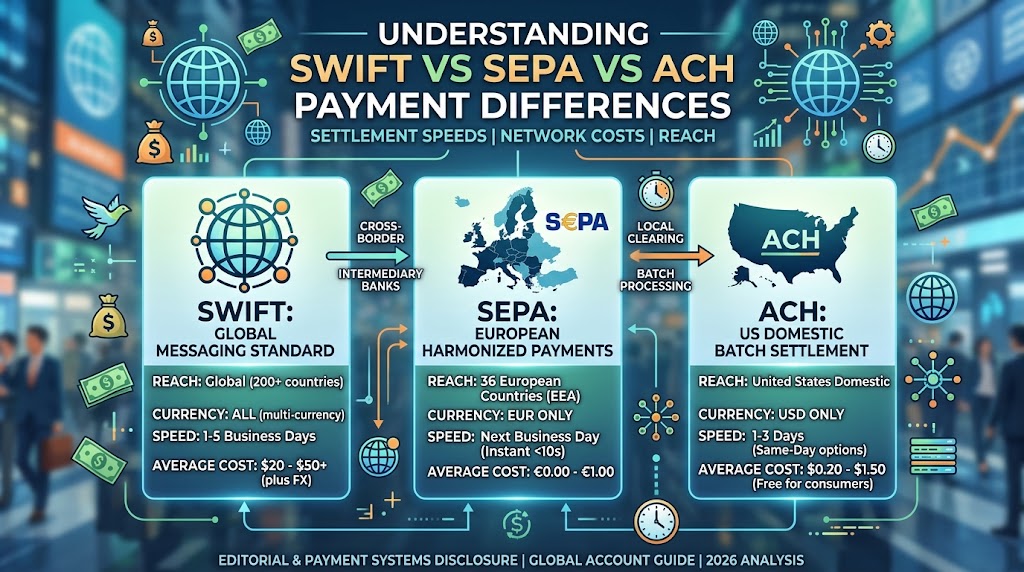
Understanding how money moves across borders is essential for reducing transaction friction. In this guide, we analyze swift vs sepa vs ach payment differences, comparing settlement speeds, intermediary banking fees, regulatory clearing protocols, and currency limitations to help you optimize international transfers in 2026.
Editorial & Payment Systems Disclosure: Global Account Guide provides independent payment infrastructure analysis and cross-border financial education. Clearing times, batch processing windows, and transaction caps are governed by central bank payment operators and regulatory authorities including Nacha and the European Payments Council. Review our Financial Disclaimer for complete compliance details.
The Three Pillars of Global Electronic Funds Transfer
Modern international commerce relies on distinct domestic and international settlement rails. While legacy institutions historically defaulted to correspondent networks for all cross-border transactions, modern fintech platforms leverage domestic clearing schemes to execute real-time, low-cost settlement.
To choose the right payment method for payroll, invoicing, or personal remittances, one must evaluate the core mechanics behind the swift vs sepa vs ach payment differences.
Comparison Matrix: SWIFT vs SEPA vs ACH Payment Differences (2026)
The table below summarizes the technical specifications, geographic reach, settlement velocity, and fee structures of each payment network:
| System | What it does | Check before paying |
|---|---|---|
| SWIFT | Financial messaging; settlement follows the banks’ payment arrangements. | Route, currency, intermediary charges, recipient fees and delivery estimate. |
| SEPA | Euro payment schemes across the current eligible area. | Provider participation, standard or instant service, account compatibility and fees. |
| ACH | US payment network supporting credits and debits, including same-day options. | Cutoffs, service selected, funds availability, returns and provider charges. |
1. SWIFT: The Global Messaging Standard
The Society for Worldwide Interbank Financial Telecommunication (SWIFT) is not a funds-clearing entity; it is a secure messaging protocol connecting over 11,000 financial institutions globally. When Bank A transfers funds to Bank B without a direct liquidity relationship, the payment passes through intermediary “correspondent banks.”
- The Correspondent Cost Drag: Each intermediary bank along the SWIFT chain deducts a processing fee ($10–$25) and applies currency conversion margins, as detailed in our analysis of Wise vs traditional bank wires.
- When to Use SWIFT: Essential for high-value B2B transactions, institutional capital transfers, real estate purchases, and routing to jurisdictions lacking integrated domestic clearing rails.
2. SEPA: Europe’s Unified Domestic Payment Area
The Single Euro Payments Area (SEPA) harmonizes electronic Euro payments across the European Economic Area, Switzerland, and the UK. Under EU regulations, a cross-border SEPA transfer cannot cost more than a domestic transfer within the same member state.
- SEPA Standard vs. SEPA Instant: Standard SEPA clears within one business day, while SEPA Instant Credit Transfer settles in under 10 seconds 24/7/365 across participating European institutions.
- Local Settlement Integration: Non-EU businesses can access SEPA directly by generating dedicated Euro coordinates through a virtual IBAN account.
3. ACH: The US Domestic Electronic Backbone
Governed by Nacha, the Automated Clearing House (ACH) handles batch-processed direct deposits and direct debits in the United States. ACH operates as the standard mechanism for domestic payroll, recurring subscription debits, and funding US brokerage and credit card accounts.
For card repayment, follow the issuer’s accepted methods and account requirements. ACH is a common option, not a universal mandatory route. Receiving details or a foreign IBAN do not automatically support card autopay.
SWIFT vs SEPA vs ACH Payment Differences: Strategic Setup for Global Operations
To eliminate unnecessary intermediary fees and optimize settlement times, international enterprises and freelancers should construct a tiered payment strategy:
- Compare local routes: Verify available funding and payout methods for the payer and recipient. Local rails may reduce correspondent costs but do not remove every conversion or provider fee. Compare the full quote.
- Convert at Interbank Rates: Convert foreign exchange inside multi-currency apps rather than relying on destination bank retail spreads.
- Reserve SWIFT for Unsupported Currencies: Limit SWIFT wire usage strictly to destination corridors that lack local automated clearing agreements.
Diagnose a payment problem before choosing another rail
A delayed receipt can involve different stages. Record the stage and reference before sending a second payment; a duplicate transfer can create a new problem.
| Stage | Question for the provider | Information to retain |
|---|---|---|
| Funding | Has the provider received and cleared the money? | Funding method, debit date and receipt |
| Conversion | Was conversion required, quoted and completed? | Currencies, quote, charges and expiry |
| Payment instruction | Which service was used, and was it accepted? | Reference, sender, beneficiary and service |
| Recipient credit | Is the recipient bank reviewing or processing it? | Expected amount, deductions and availability notice |
| Error or suspected fraud | What trace, recall or recovery process is available? | Contact time and the provider’s case reference |
Ask the provider to distinguish an estimate from confirmed status. Changing from ACH to a wire or from a standard euro transfer to an instant option does not cure incorrect beneficiary details, unsupported receiving instructions or an unresolved compliance review. Get instructions for the actual payment before trying again.
Frequently Asked Questions
Can I send USD directly through the SEPA network?
SEPA schemes concern euro payments. If you start with another currency, obtain the provider’s actual conversion and payment instructions. Do not assume a USD instruction will automatically be converted or rejected in a particular way.
What is the difference between ACH Direct Deposit and Fedwire?
ACH offers same-day and scheduled processing options; timing depends on the selected service and cutoffs. Nacha explains these options. Fedwire is a separate funds-transfer service. Compare your provider’s availability, fee and delivery terms rather than treating one retail price range as universal.
Are SEPA Instant payments irreversible?
If an instant payment has been executed, contact your provider immediately about an error or suspected fraud. Ask what recall or recovery process is available; do not assume you can cancel a completed transfer or that recovery is guaranteed.