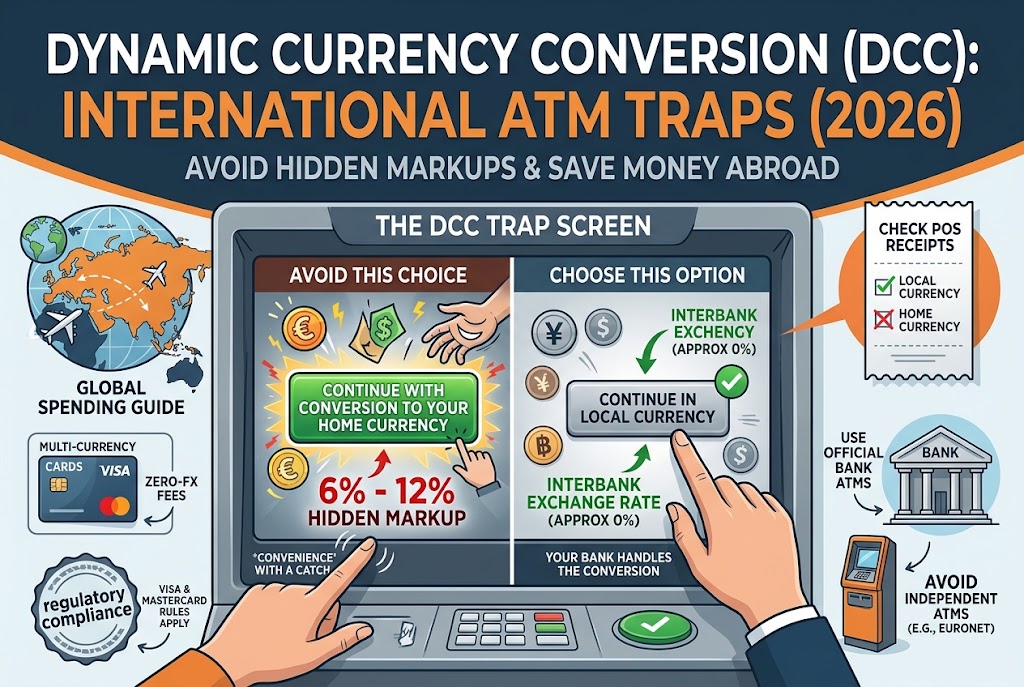
Withdrawing cash or paying for a meal abroad often presents an unexpected trap at the payment terminal. Falling for the dynamic currency conversion atm scam can quietly add 6% to 12% in hidden markups to your transactions, turning an otherwise routine purchase into an expensive tourist surcharge.
Editorial & Financial Safety Notice: Global Account Guide provides factual guides on international spending, ATM fee avoidance, and cross-border consumer protections. Foreign exchange rates, merchant acquiring regulations, and terminal compliance rules vary by jurisdiction. Review our Financial Disclaimer for regulatory details.
What Is Dynamic Currency Conversion (DCC)?
Dynamic Currency Conversion (DCC), sometimes marketed as Cardholder Preferred Currency (CPC), is an optional financial service offered at international ATMs and Point-of-Sale (POS) terminals. When you insert or tap a foreign-issued card, the terminal identifies the card’s origin and asks whether you prefer to be billed in the local currency or in your domestic home currency (e.g., USD, GBP, or EUR).
While pitched under the guise of convenience, accepting this prompt triggers an aggressive foreign exchange spread. Instead of letting your card issuer or multi-currency platform perform the conversion at wholesale interbank rates, you hand the pricing power over to the merchant’s local acquiring bank, which inflates the exchange rate to capture a substantial profit margin.
How the DCC Exchange Rate Markup Works
Understanding the difference between standard card processing and the dynamic conversion mechanism highlights why DCC is widely regarded as a legal consumer trap:
- Standard Multi-Currency Transaction: The terminal charges you in local currency (e.g., Japanese Yen). The transaction routes directly through Visa, Mastercard, or your multi-currency provider (such as Wise or Revolut), applying live interbank rates with a minimal spread (0.0% to 0.5%).
- DCC Transaction Path: The terminal performs the conversion locally. The ATM operator or merchant processor applies an arbitrary retail exchange rate with an embedded 6% to 12% spread, plus an additional conversion processing fee. The operator and merchant then split this generated spread as a kickback commission.
Comparison Guide: How the Dynamic Currency Conversion ATM Scam Operates
Protecting your funds from the dynamic currency conversion atm scam requires strict discipline at every merchant terminal and cash machine.
Independent ATM operators and tourist-heavy merchant terminals use interface designs and psychological cues to encourage users to accept unfavorable conversions. The table below details standard screen prompts and the correct action to take:
| Screen Prompt | Design Tactic | Real Financial Cost | Action to Take |
|---|---|---|---|
| «Continue with Conversion» | Bright green button / Prominent placement | 6% – 10% predatory markup applied | Decline / Cancel |
| «Continue without Conversion» | Small grey font / Secondary button | Interbank market exchange rate | Accept / Select |
| «Lock In Your Guaranteed Rate» | Framed as protection against volatility | Embeds guaranteed high operator spread | Reject / Pay Local |
| «Charge in [Home Currency] vs [Local]» | Shows familiar currency amount first | Severe conversion surcharge | Select Local Currency |
The Independent ATM Trap: Euronet and Tourist Kiosks
Standalone, white-label ATMs located at international airports, central train stations, and popular nightlife districts frequently practice the most aggressive DCC implementations. Operators such as Euronet or NoteMachine often bundle two separate fees into a single cash withdrawal:
- Direct Access Surcharge: A mandatory operator fee of $3.00 to $6.00 simply for using the terminal.
- DCC Spread Markup: An inflated conversion rate applied directly to your home balance if you click through the automated prompts without declining.
To avoid these compounding charges, withdraw local currency from official retail bank ATMs (such as BNP Paribas, Deutsche Bank, or Santander) located directly within physical bank branch lobbies rather than standalone outdoor kiosks.
Essential Rules to Avoid Dynamic Currency Conversion
- Always Select the Local Currency: Whether paying for dinner, buying a train ticket, or withdrawing cash, choose the currency of the country you are physically standing in.
- Check the POS Receipt Before Authorizing: If a merchant terminal displays your home currency automatically without giving you an on-screen choice, ask the clerk to re-run the charge in the local currency.
- Use Zero-FX Multi-Currency Cards: Pairing your international transactions with a verified multi-currency debit card ensures your funds draw directly from native currency pots at interbank rates.
Regulatory Standards and Consumer Protections
Under Visa and Mastercard global operating regulations, merchants and ATM operators are legally required to present the consumer with a clear, active choice between local currency and dynamic conversion. They are strictly prohibited from pre-selecting DCC on behalf of the customer.
In addition, financial regulators like the UK Financial Conduct Authority (FCA) and the European Central Bank continue to enforce transparency standards requiring terminals to disclose the total percentage markup relative to official benchmark exchange rates.
Frequently Asked Questions
Is the dynamic currency conversion ATM scam illegal?
No, DCC is technically a legal financial service. However, because its interface designs rely on confusing prompts and hidden fees to steer travelers into expensive conversions, it is widely considered an exploitative practice.
What should I do if a card machine charges me in home currency without asking?
You have the legal right under payment card network rules to decline the receipt, request that the transaction be voided immediately, and insist on paying in the local currency.
Does paying in local currency prevent all ATM fees?
Paying in local currency eliminates the DCC foreign exchange markup. However, independent terminal operators may still charge a separate, flat out-of-network access fee. Using a travel card with ATM fee rebates provides complete protection against these costs.