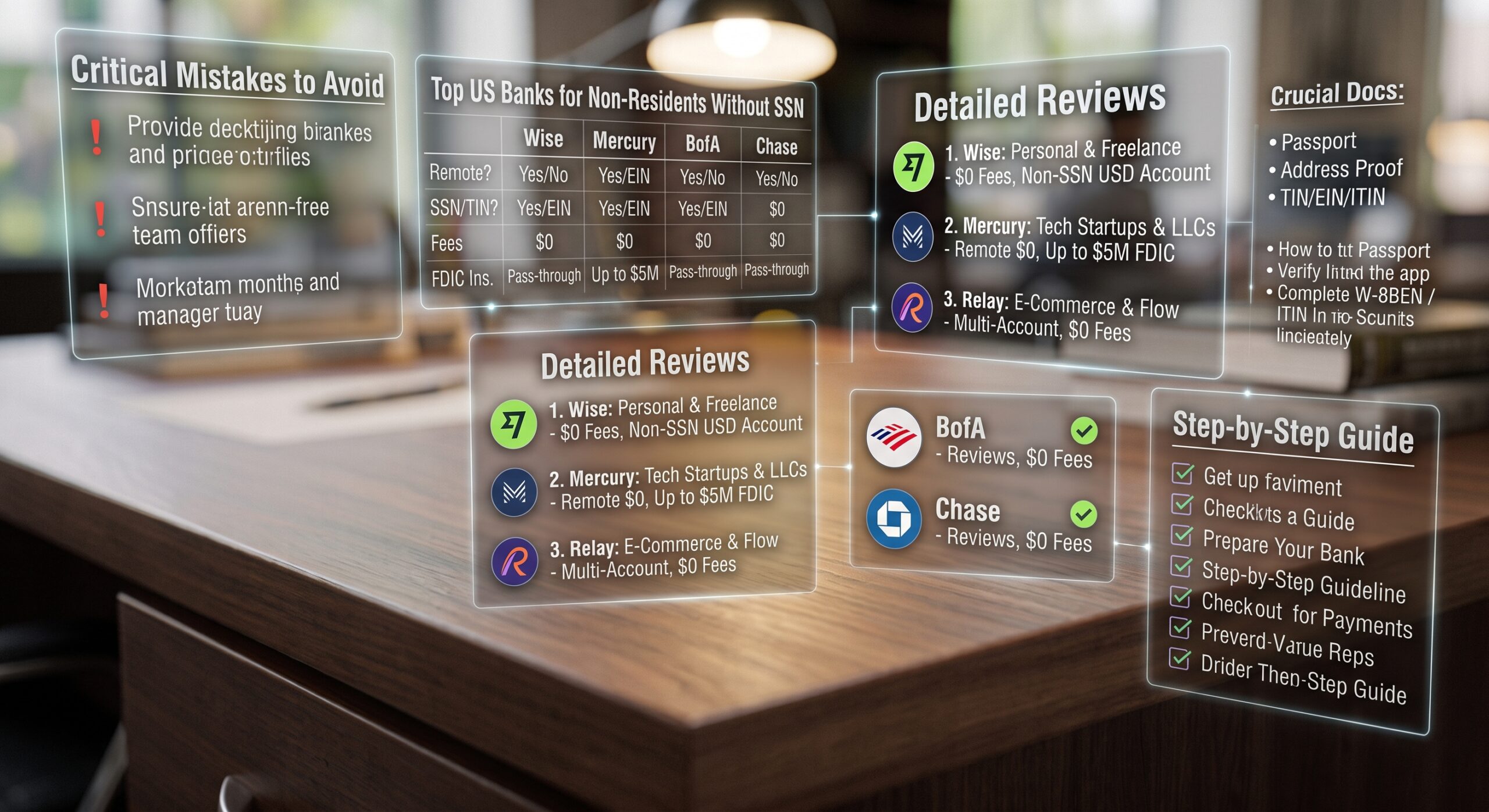
There is no single account available to every non-resident without an SSN. This guide separates personal payment needs from business banking and identifies the checks to make before submitting an application.
Whether you manage a global e-commerce business or invoice international corporate clients in USD, selecting the right platform is essential to avoid frozen funds and excessive wire fees. This comprehensive guide reviews and ranks the best US banks for non-residents without SSN in 2026, breaking down remote requirements, compliance steps, and feature comparisons.
Best US Banks for Non-Residents Without SSN: Full Comparison
| Option | What to check before applying | Protection and costs |
|---|---|---|
| Wise USD details | Availability for your residence and personal or business profile. Receiving details are not a bank account. | Check the terms for your exact balance product, receiving route and conversion quote. |
| Mercury | Business eligibility, actual operating address, owners and supporting documents. | Read the partner-bank and sweep disclosures; do not assume every balance has the same protection. |
| Relay | Confirm current country, entity and identity requirements directly with the provider. | Check the selected plan, fee schedule and deposit agreement. |
| A traditional US bank | Ask about your residency, identification, tax number and branch requirements for the specific account. | Check the insured bank, account ownership category, fees and waiver conditions. |
Detailed Reviews: The Best US Banks for Non-Residents Without SSN
1. Wise: Best for Personal USD Collection & Freelance Invoicing
Check Wise’s USD receiving-details guidance for availability and supported payments. A passport alone does not establish eligibility. Verify the features shown for your residence and account type before asking clients to pay you.
- Eligibility: Check residence and the requested USD receiving features in Wise’s USD-details guidance. A global customer count or a list of transfer destinations does not establish account availability.
- Key Advantage: Direct mid-market exchange rates with minimal, transparent FX conversion fees.
- Limitation: It functions as an electronic money institution rather than a chartered full-reserve bank.
2. Mercury: Best for Remote US LLC Founders & Tech Startups
A passport and EIN alone are not a complete Mercury application. Review its document checklist and eligibility requirements before forming a company solely to obtain banking access.
- Eligibility: Active US corporate entities with valid foreign beneficial ownership.
- Deposit protection: Mercury states that eligible checking and savings deposits can receive up to $5 million of FDIC coverage through its partner banks and sweep network, subject to pass-through requirements. Mercury is a fintech, not an insured bank, and Treasury investments are not FDIC-insured. Check Mercury’s current insurance explanation and your account’s bank allocations.
- Limitation: Personal banking is not supported; applicants must hold a registered US company.
3. Relay Financial: Best for E-Commerce & Cash Flow Management
Relay delivers multi-account structures tailored to digital businesses managing various operating expenses. Non-resident business owners can establish up to 20 individual checking accounts and issue up to 50 physical or virtual cards completely online.
- Eligibility: Non-resident founders owning a legally registered US LLC or C-Corp.
- Key Advantage: Direct zero-fee integrations with Stripe, PayPal, Shopify, and Amazon Seller Central.
- Limitation: Verification requires complete business formation paperwork before approval.
4. Traditional Brick-and-Mortar Banks (Chase & Bank of America)
If your enterprise handles physical cash or requires trade financing, legacy banks permit foreign non-residents to open accounts during in-person visits to a US branch:
- Bank of America: Accepts foreign passport holders who provide a secondary form of identification (e.g., driver’s license or international debit card) and proof of foreign address.
- Chase: Ask about eligibility and accepted documents for the exact account and your residence. An ITIN alone does not establish approval or the available application route.
Obtain a product-specific document checklist
Confirm accepted residence, identity documents, address evidence and tax information directly with the institution. The list for a personal account differs from the list for a company account; a passport and EIN alone do not establish approval.
Ask which documents need translation, certification or a particular issue date. Record the answer before spending money on copies or an intermediary. For business applications, distinguish the company’s legal address from its physical operating address and disclose both truthfully.
Step-by-Step Guide: How to Apply Remotely
- Select Your Account Structure: Determine if your activity requires a personal multi-currency hub (Wise) or a dedicated US LLC business checking account (Mercury or Relay).
- Prepare Translated Records: Confirm that foreign utility bills and identity files are translated into English.
- Perform Biometric ID Verification: Upload clear passport scans and perform live facial recognition via a mobile device.
- Execute an Initial Deposit: Send a verification wire or card deposit to activate your US routing details. Learn more about optimal setup in our comprehensive guide on how to open a US bank account as a non-resident.
Avoid costly application shortcuts
Do not use a mailbox as a residential or operating address when the provider requires the actual location. Do not submit a tax-status form merely because it appears in a general checklist: holder type, income and the provider’s request matter.
Provide an accurate description of expected payments and keep records explaining significant transactions. A small initial transfer or a period of low activity does not guarantee that later payments will avoid compliance review.
Final Verdict
Choose by requirements rather than a universal ranking: personal or business use, eligible residence, payment routes, total fees, deposit terms and support. Request clarification from the provider when its application does not cover your situation.