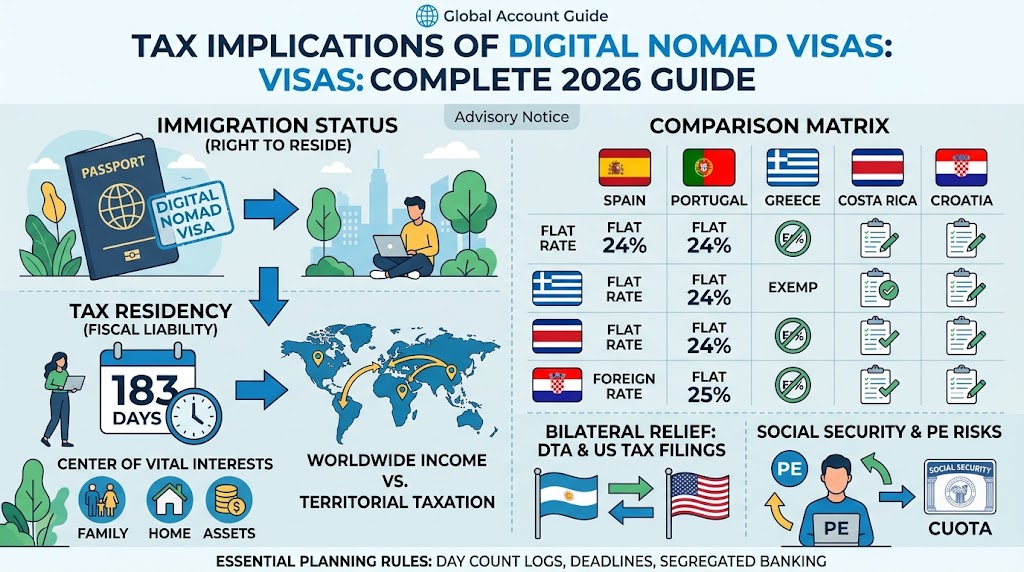
Relocating abroad on a remote permit offers geographic flexibility, but confusing immigration permissions with fiscal obligations creates severe financial liabilities. Navigating digital nomad visa tax implications requires understanding how international tax residency triggers, flat-tax incentive schemes, and bilateral double taxation treaties govern cross-border remote earnings.
Editorial & Tax Advisory Notice: Global Account Guide delivers independent international finance analysis. Tax residency criteria, bilateral double taxation treaties, and local social security contribution schemes vary by nationality and host nation legislation. Review our Financial Disclaimer and consult an accredited international cross-border tax attorney.
Immigration Status vs. Tax Residency: The Critical Distinction
One of the most dangerous assumptions among remote workers is believing that holding a digital nomad visa automatically grants tax-free living. In international law, these two concepts operate under completely separate jurisdictions:
- Immigration Status (The Right to Reside): Granted by the Ministry of Foreign Affairs or Immigration Department, permitting legal physical presence and remote work without violating domestic labor laws.
- Tax Residency (Fiscal Liability): Enforced by the Ministry of Finance or National Tax Agency based on statutory physical presence rules, economic ties, and source-of-income principles.
Core Principles Governing International Tax Residency
1. The 183-Day Physical Presence Rule
Most OECD member countries enforce the standard 183-day rule. Spending more than 183 days (consecutive or aggregated) within a calendar year or consecutive 12-month period in a host nation automatically classifies you as a statutory tax resident, subjecting your worldwide income to progressive domestic taxation.
2. Center of Vital Interests
Even if you spend fewer than 183 days in a country, local tax authorities can deem you a fiscal resident if your core personal and economic ties remain located there. This includes holding a permanent family home, having dependent children enrolled in local schools, or maintaining primary commercial business assets in the territory.
3. Worldwide Income vs. Territorial Taxation
Most European and North American countries operate under worldwide taxation regimes, claiming taxing rights over all income generated globally. Conversely, territorial tax jurisdictions (such as Costa Rica or Georgia) only tax income derived from local economic sources within their borders.
Comparison Matrix: Digital Nomad Visa Tax Implications by Country (2026)
The table below summarizes local income tax rates, special expatriate tax breaks, and foreign asset declaration mandates across top digital nomad visa jurisdictions:
| Country / Visa Scheme | Standard Tax Rate | Special Nomad Tax Regime | Foreign Asset Declaration | Duration of Benefit |
|---|---|---|---|---|
| Spain (Ley Beckham / DNV) | Progressive (19% – 47%) | 24% flat tax (up to €600,000) | Exempt on non-Spanish assets | Up to 6 tax years |
| Portugal (D8 Visa) | Progressive (14.5% – 48%) | Standard progressive rates | Mandatory worldwide reporting | Annual filing |
| Greece (Law 4825/2021) | Progressive (9% – 44%) | 50% income tax exemption | Standard Greek tax return | Up to 7 years (min. 2 yr stay) |
| Costa Rica (Estancia Nomad) | Progressive (0% – 25%) | 100% foreign income exemption | Fully exempt | 1 year (renewable +1 year) |
| Croatia (Nomad Permit) | Progressive (20% – 30%) | 100% tax exemption on remote work | Fully exempt | Up to 1 year (non-renewable) |
Bilateral Relief: Double Taxation Agreements and US Tax Filings
To avoid paying full income taxes to both your country of origin and your host government, international fiscal frameworks rely on bilateral Double Taxation Agreements (OECD DTAs):
- Tax Credits and Exemptions: DTAs ensure that taxes paid in your country of physical residence can be claimed as a credit against liabilities in your country of fiscal origin.
- Rules for US Citizens (CBT Framework): Because the United States taxes based on citizenship regardless of global residency, American nomads must file annual IRS returns. However, they can leverage the Foreign Earned Income Exclusion (FEIE / Form 2555) or Foreign Tax Credit (FTC / Form 1116) to offset domestic federal obligations.
- Tax Residency Certificates: Consulates often require a certified certificate of fiscal residency from your home authority to confirm that your foreign income is declared and compliant under international information sharing protocols.
Beyond individual income taxes, digital nomads and their employers face corporate and payroll liabilities:
In many EU destinations, obtaining local tax residency mandates contributing to local autonomous self-employed health and pension systems (such as the Spanish cuota de autónomos) unless a bilateral Social Security Totalization Agreement exempts you via a formal Certificate of Coverage.
2. Corporate Permanent Establishment (PE)
If you are a high-level executive or hold signatory authority to enter into contracts on behalf of a foreign employer, working from a host nation on a nomad visa risks creating a taxable Permanent Establishment for your foreign company, exposing company profits to local corporate tax audits.
Essential Fiscal Planning Rules for Remote Workers
- Maintain Strict Day-Count Logs: Keep boarding passes, flight receipts, and passport stamps organized to substantiate exact physical presence periods during tax audits.
- Register Within Statutory Deadlines: In countries with favorable flat-tax incentives (such as Spain’s Modelo 149 under the Beckham Law), applications must be submitted within rigid statutory windows (typically within 6 months of social security registration).
- Keep Business Banking Completely Segregated: Process foreign client retainers and salaries through verified international platforms, such as dedicated virtual IBAN accounts, to clearly distinguish cross-border remote business cash flow from personal local living expenses.
Frequently Asked Questions
Do I have to pay local income taxes if I stay less than 183 days?
Generally no, provided you do not trigger local tax residency rules through the center of vital interests. However, some jurisdictions enforce tax withholding on local source income even for short-term non-resident stays.
Does a digital nomad visa exempt me from home country taxes?
No. An immigration visa does not break your domestic tax residency. You must follow statutory tax departure protocols in your home country to formally sever local tax filing obligations.
Can I use a nomad visa to run a local business in the host country?
No. Digital nomad visas strictly prohibit conducting business in the local domestic economy or invoicing local domestic clients. All economic revenue must derive exclusively from foreign entities.